Guide
Coating a warehouse floor while the unit stays in use
A live warehouse cannot shut down for days. Find out how specialist contractors phase resin work bay by bay, keep forklifts moving, and protect staff from fumes and wet surfaces during the job.
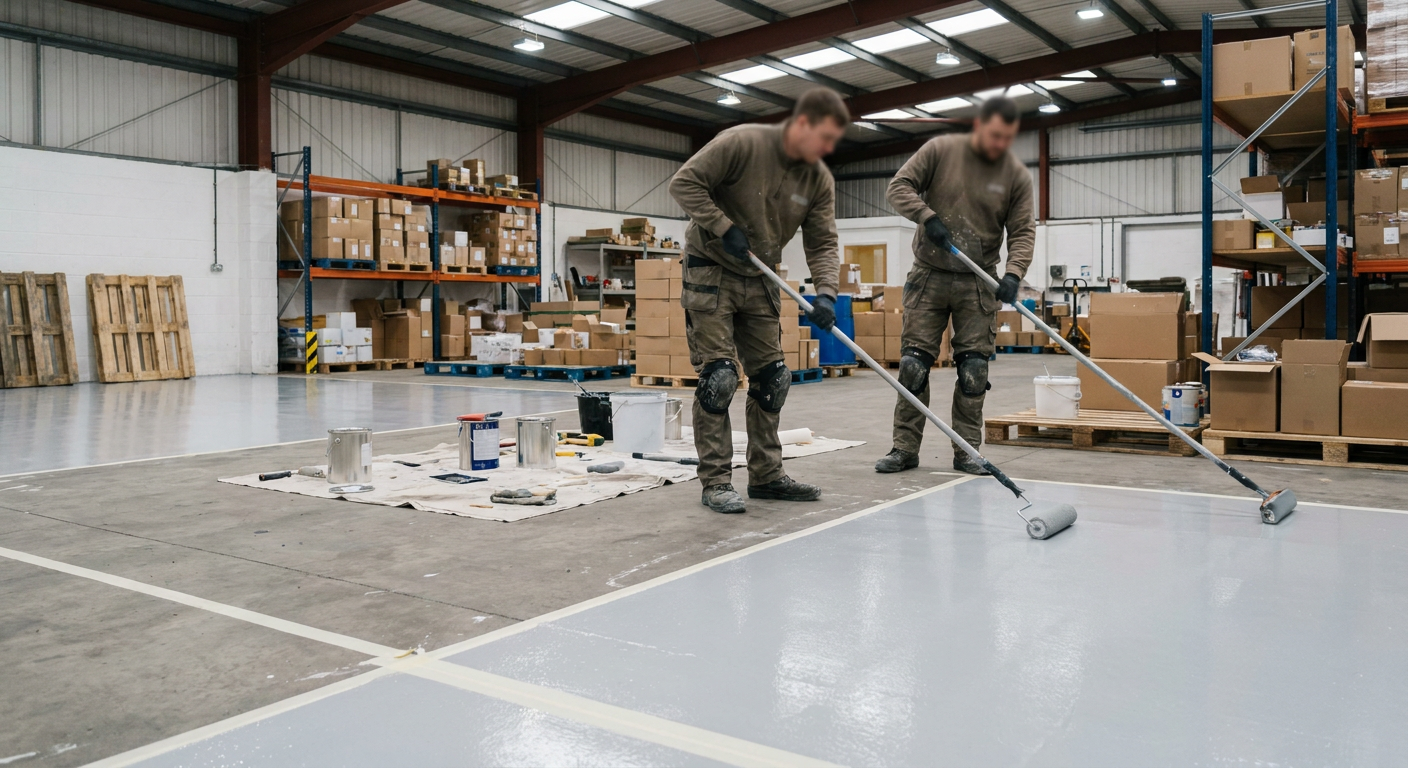
Planning the work around daily operations
Shutting a warehouse to coat the floor costs money every hour it sits empty. Specialist contractors avoid that loss by splitting the space into zones. They map out which bays can be emptied first and where stock needs to move before any grinding starts.
The plan accounts for delivery schedules, shift patterns and the routes forklifts take between racking. A contractor will often start in the least active corner of the building, finishing one zone completely before opening the next. This keeps goods flowing through the unit without crossing wet resin or freshly ground concrete.
Communication matters as much as the schedule. Warehouse managers need to know exactly when a zone becomes unavailable and when it reopens to traffic. The specialist firm sets these boundaries with physical barriers rather than tape on the floor, so nobody walks onto a surface that is still curing.
Preparing concrete without stopping the business
Resin fails when applied over dust, oil or old flaking paint. Preparation removes all of it, but the process creates noise and debris. In an operating warehouse, containment is the main problem.
Specialist firms use vacuum-assisted grinders and shot blasters that capture dust at the source. They seal off the active zone with temporary sheeting so airborne particles do not settle on stored goods or packaging lines. Any oil stains get treated with degreasers that do not leave a residue the new coating would reject.
Moisture is another factor. Concrete slabs in older units often hold dampness that causes epoxy to peel later. Contractors test the slab before choosing a system. If moisture readings are high, they may apply a damp-tolerant primer or switch to a moisture-curing polyurethane. Skipping this check risks the whole job lifting within months.
Keeping staff and vehicles safe during application
Epoxy and polyurethane resins release vapours while they cure. In a confined warehouse, ventilation has to be managed carefully so fumes do not drift into occupied areas. Contractors position extraction fans to pull air away from working staff and vent it outside.
Pedestrian routes must stay clear at all times. The specialist firm marks safe walkways with temporary cones and barriers, updating them as each bay dries. Forklift drivers receive specific instructions about which aisles are closed and where alternative routes run.
Slip risk is highest when the coating goes down. Anti-slip additives can be broadcast into the wet resin, giving the finished surface grip even when damp. But during application, the wet area itself is hazardous. Nobody enters the zone without the correct footwear, and the contractor controls access until the film has set enough to bear weight safely.
Curing times and returning bays to service
A coated floor is not ready for pallet trucks the moment it looks dry. Epoxy cures in stages. Foot traffic might be possible after twelve hours, but heavy forklift wheels will mark a surface left for anything less than the full cure window.
Specialist contractors plan the phasing around these drying times. If a bay is coated on Monday morning, it might accept light footfall by Tuesday and full vehicle loads by Thursday. The schedule builds in that gap so warehouse staff do not guess when it is safe to move stock back.
Temperature affects the timeline. Cold slabs slow the chemical reaction, extending the wait. Contractors monitor ambient conditions and sometimes use heaters to keep the curing zone within the range the resin manufacturer specifies. Rushing this stage leads to soft spots that wear out under tyres within weeks.
Choosing the right system for a live environment
Not every resin suits a working warehouse. Thick, heavily filled screeds take longer to lay and longer to cure. Thin roller-applied coatings go down fast but offer less protection against steel-wheeled trolleys and dropped tools.
The specialist firm selects the system based on what travels over the floor. A unit handling food and drink needs a seamless, washable surface that tolerates frequent mopping. A distribution centre running electric forklifts all day needs thickness and abrasion resistance above everything else.
Polyurethane handles thermal shock better than epoxy, so units with loading bays open to cold air often benefit from it. Epoxy remains the standard for most indoor warehouse floors because of its hardness and lower cost per square metre. The contractor weighs these factors against the time available for each phased zone.
Ask about coating your warehouse floor
Send details about your unit and the work you need. A specialist firm will read them and reply with advice. There is no obligation to proceed.
- No commitment required
- Direct technical advice
- UK-wide coverage